


Caffeine-Free Pre-Workout: What Works and How to Choose
A caffeine-free pre-workout is a pre-training supplement built on ingredients such as citrulline, beta-alanine and taurine instead of a stimulant. It will not give the alertness lift of a coffee, so the right choice depends on what you want from it: a pump, support for harder sets, an evening session without wrecked sleep, or a gentler daily routine. Below: how the main ingredient types compare, what the research says, the doses to look for on a label, and where thecary’s range fits around a training plan.
Key Takeaways
- A caffeine-free formula removes the stimulant effect. In a 2022 trial, only the caffeinated product raised subjective energy over placebo.
- Evidence for non-stimulant ingredients is mixed and formula-specific. Beta-alanine and creatine work through regular use over weeks, not one scoop.
- Dose matters more than the ingredient list. Many multi-ingredient products contain less than the amounts studied, and proprietary blends hide the figures.
- Caffeine-sensitive people and those who train in the evening are the main groups who choose stimulant-free.
- A supplement sits on top of sleep, food and training. Daily foundations such as magnesium and sleep support are part of the same routine.
Table of Contents
- What caffeine-free actually means
- Who tends to choose a pre-workout without caffeine
- The main ingredient types compared
- What the research says about performance
- How to read a label
- Types of caffeine-free option on UK shelves
- Why a daily routine beats a pre-session scoop
- thecary’s approach to supplements around training
- FAQ
- Sources
What caffeine-free actually means
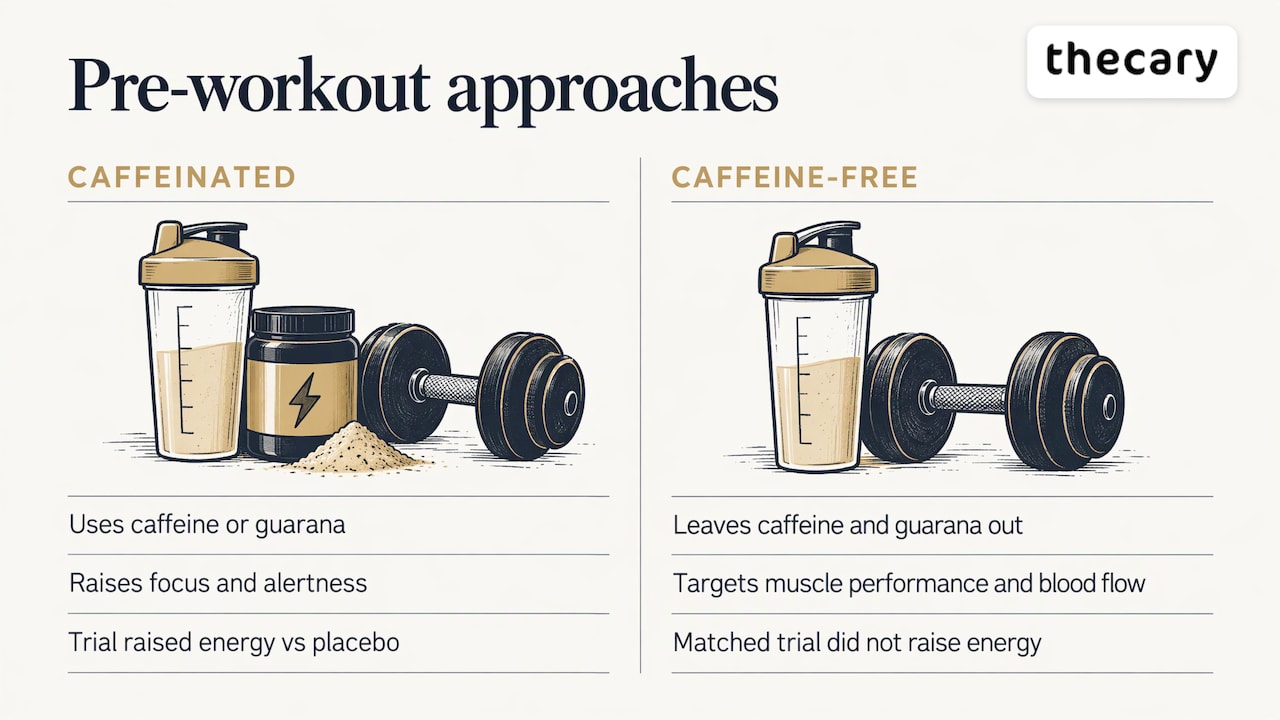
The terms “caffeine free”, “stimulant free” and “without caffeine” describe the same idea. A standard pre-workout usually relies on caffeine or guarana to raise focus and alertness, as Anglia Ruskin University explains. A stimulant-free version leaves those out and keeps the ingredients aimed at muscle performance and blood flow.
The practical difference is felt rather than measured. In a 2022 crossover trial of 24 resistance-trained adults, the matched caffeinated formula (350 mg caffeine plus 350 mg L-theanine) raised subjective energy over placebo, and the non-caffeinated version did not. So a caffeine-free product should not be judged on whether it “hits” like a stimulant. It is judged on training quality, consistency and how you sleep afterwards.
“Natural” is a looser term. It has no fixed legal meaning on a supplement tub. In practice, readers use it to mean plant-derived or amino-acid-based ingredients, without artificial stimulants. Check the label for the actual compounds and amounts instead of the word.
Who tends to choose a pre-workout without caffeine
The 2022 study names two groups interested in non-caffeinated products: caffeine-sensitive people and people who train later in the day. The ARU researchers make a similar point: people training later may choose lower or no caffeine.
Other common reasons:
- Jitteriness or a racing heart from stimulant formulas.
- Evening or night-shift training where sleep matters.
- A preference for a simpler, daily-use supplement rather than something taken only on gym days.
- Older lifters who want to support training without a stimulant load.
If you are pregnant, take medication, or have a heart or blood-pressure condition, speak to your GP or pharmacist before adding any new supplement, caffeinated or not.
The main ingredient types compared
Most caffeine-free pre-workouts are built from a handful of ingredients. This table sets out what each is used for, the amount commonly studied and how the evidence reads.
| Ingredient | Used for | Dose seen in research | Evidence picture |
|---|---|---|---|
| Citrulline (often as citrulline malate) | Blood flow, pump, endurance | 6 to 8 g daily is the range often studied; the 2022 formula used 8 g citrulline malate | Limited and mixed; some studies show benefit, some none |
| Beta-alanine | High-intensity efforts of roughly 1 to 4 minutes | 4 to 6 g daily for at least two weeks; the 2022 formula used 3.6 g | Small gains in some activities; tingling is common |
| Betaine | Strength and power support | 2.5 g in the 2022 formula | Studied inside multi-ingredient blends |
| Alpha-GPC | Focus without a stimulant | 300 mg in the 2022 formula | Studied inside multi-ingredient blends |
| Taurine and tyrosine | Focus and fatigue perception | Varies by product | Mostly sold on label claims |
| Creatine | Strength, repeated high-intensity work | Works through regular use over about four weeks | Better supported as a daily supplement than a pre-session one |
The doses come from the 2022 trial and a 2018 review of multi-ingredient pre-workouts, which reports 4 to 6 g of beta-alanine daily for at least two weeks as the amount shown to improve high-intensity performance, and 6 to 8 g daily as the usual citrulline range.
Citrulline and arginine: the pump ingredients
Citrulline and arginine can raise nitric oxide and blood flow, which is why products built on them are sold as “pump” formulas. ARU notes that this may support endurance or temporary muscle fullness, but also that not all evidence supports these effects. The US National Institutes of Health fact sheet describes the citrulline evidence as limited. Read a pump product as a training aid, not an energy product.
Beta-alanine: needs time
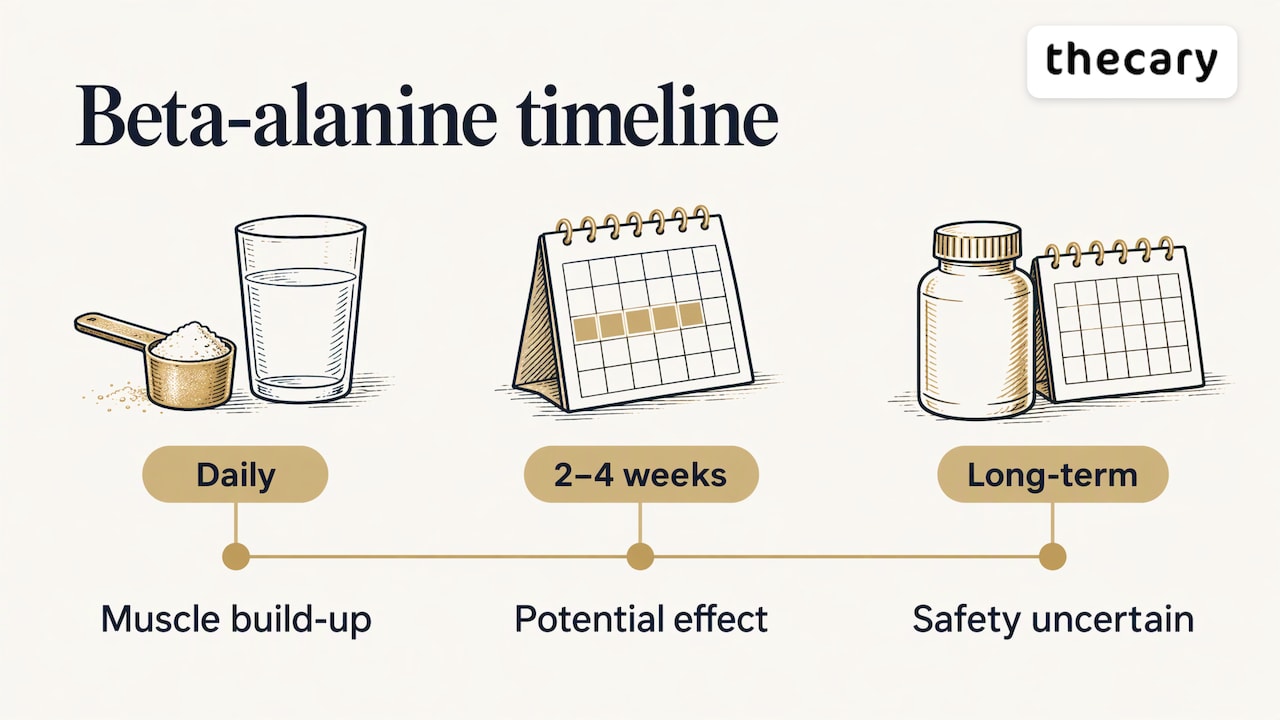
Beta-alanine builds up in muscle through daily use. ARU says it needs to be taken daily for around 2 to 4 weeks to have an effect. Anyone expecting a first-scoop result will be disappointed. Tingling of the skin is a known effect, and the NIH notes that long-term daily safety beyond several months is uncertain. If the itch bothers you, a lower serving or a split dose is the usual approach, and a product with a clear per-serving figure makes that easy.
Creatine: a daily habit
Creatine behaves like beta-alanine: it works through regular use over roughly four weeks, not a single pre-session dose. A pre-workout that contains it is best treated as part of a daily routine, taken on rest days too.
What the research says about performance
The honest summary is that results are mixed, and they differ from formula to formula.
In the 2022 trial, both the caffeinated and non-caffeinated formulas improved isometric squat peak force, but neither improved bench press, leg press or isokinetic squat performance versus placebo. A 2017 placebo-controlled trial in 21 resistance-trained adults found that neither a caffeinated nor a non-caffeinated multi-ingredient product significantly improved force during the sets. Subjective energy, focus and fatigue ratings changed similarly after supplement and placebo, which shows how much of a pre-workout “feeling” can be expectation.
The ARU researchers, Justin Roberts, Fernando Naclerio and Joseph Lillis, conclude that pre-workouts may modestly help performance, but that some ingredients need consistent use over weeks. For a caffeine-free formula, that means judging it over a month of training, not one session.
How to read a label
A 2018 review in the Journal of the International Society of Sports Nutrition found that undisclosed proprietary blends make doses and efficacy hard to judge, and that short-term studies of multi-ingredient products do not establish long-term safety. The same review’s authors note that doses in multi-ingredient pre-workouts are generally lower than the amounts linked to benefits. That gives a practical checklist:
- Every ingredient has its own gram or milligram figure. A single “proprietary blend” total tells you nothing.
- Compare the dose per serving with the studied range in the table above, then work out the cost per serving at that dose, not per tub.
- Count how many scoops a serving is. Some labels quote a half-serving.
- Look for third-party testing and manufacturing certification. The International Olympic Committee consensus advises athletes to investigate supplement ingredients and consider contamination risk.
- Check for added stimulants. Some “stim-free” labels still list guarana, green tea extract or yerba mate. Those contain caffeine.
- Match the ingredient to the training. Pump ingredients for lifting volume, beta-alanine for sets lasting one to four minutes, creatine as a daily base.
Types of caffeine-free option on UK shelves
UK retailers and sports brands sell caffeine-free products in three broad forms. Prices vary by retailer and change with promotions, so compare cost per serving on the product page on the day you buy.
| Type | What it looks like | Best for | Watch for |
|---|---|---|---|
| Pump powders | Citrulline, arginine or AAKG, often with beta-alanine and betaine | Lifting sessions, volume work | Sub-study doses, blends without figures |
| Focus-style formulas | Alpha-GPC, tyrosine, taurine | Evening sessions needing concentration | Effects are largely subjective |
| Single ingredients taken daily | Creatine, beta-alanine, citrulline, magnesium | Anyone who wants control of each dose | Needs weeks of consistent use |
| Wellness-led routine | Energy, sleep and daily wellness products built around training | Preventative, long-term health | Not a substitute for training specifics |
The fourth row is where thecary fits. thecary makes clinically dosed supplements for preventative health, with a focus on bioavailability, and its range covers energy, sleep, stress, daily wellness, bones and joints, heart health and healthy ageing. For readers who lift, that means the foundations around the session. Magnesium form is one example, covered in our guide to magnesium glycinate versus citrate. How supplements are absorbed is explained in bioavailable supplements.
Why a daily routine beats a pre-session scoop
The research points the same way from several directions. Beta-alanine and creatine need weeks. Evidence for single-session effects is weak. Perceived energy is partly expectation. A caffeine-free approach therefore rewards the reader who builds a steady routine: consistent daily doses, good sleep, and training that suits their level.
Sleep is the quiet gain from skipping stimulants. An evening session on a caffeinated formula can push bedtime later, and sleep is where recovery happens. For ideas on managing a flat day, see this guide to working out with low energy, which covers when to train lighter and when to rest.
For older lifters, the case for a steady routine is stronger still. Consistent daily intake, certified manufacturing and clear doses suit people focused on healthy ageing more than a once-off stimulant hit does.
thecary’s approach to supplements around training
thecary’s position is that a supplement should deliver what the body can actually use. Its products are clinically dosed, formulated with bioavailability in mind, and tested batch by batch. The range is vegan and GMO-free, made to GMP standards and with FSSC 22000 certification. Those are the same points that matter on any label when you are comparing products: stated doses, testing, and manufacturing standards.
For a training routine without stimulants, the energy collection and the wider range sit alongside your pre-session choice. You can browse everything by goal in the full assortment, from energy and sleep to men’s and women’s wellness.

If you want a routine built on stated doses rather than a hidden blend, start with the energy collection and the daily wellness range.
Our view
We think the useful question is not “what gives me a buzz?” but “what does my body actually need, and can I see the dose?” A pre-workout without caffeine puts the emphasis where it belongs: on consistent, clearly dosed ingredients taken over weeks, alongside good sleep and food.
That is how we build at thecary. Our supplements are clinically dosed, designed for bioavailability and tested batch by batch, under GMP and FSSC 22000 certification. We aim to deliver what the body recognises and needs, in a form you can read on the label.
For people who train, that means starting early with the foundations: energy, sleep, stress and daily wellness, so that every session starts from a better place. Early, steady habits are the heart of preventative health.
Tinashe
FAQ
Is caffeine-free pre-workout effective?
Results depend on the formula. A 2022 trial found a non-caffeinated formula improved isometric squat peak force but not bench press, leg press or isokinetic squat performance. Ingredients such as beta-alanine and creatine need weeks of daily use, so judge a product over a month, not a single session.
Is there a pre-workout without caffeine that is safe to take daily?
Many caffeine-free products use ingredients such as citrulline and beta-alanine. The NIH notes that safety beyond several months of daily beta-alanine is uncertain, and that tingling can occur. If you take medication, have a medical condition or are pregnant, check with your GP or pharmacist first.
What should I look for in a natural pre-workout?
Look for a full ingredient list with a dose for each item, no hidden stimulants such as guarana, and evidence of testing and manufacturing standards. “Natural” has no fixed meaning on a label, so the figures matter more than the word.
Will a stimulant-free pre-workout help me sleep better?
Removing caffeine removes one common cause of disrupted sleep after evening sessions. Sleep itself depends on timing, food, stress and routine, which is why sleep and stress support often sit alongside a training plan.
Sources
- The influence of caffeinated and non-caffeinated multi-ingredient pre-workout supplements (2022 trial)
- Effects of two pre-workout supplements on concentric and eccentric force (2017 trial)
- Can pre-workout supplements benefit your workout? Anglia Ruskin University
- Multi-ingredient pre-workout supplements, safety implications and performance outcomes (2018 review)
- Multi-ingredient pre-workout supplements, 2018 review full text
- Dietary Supplements for Exercise and Athletic Performance, NIH Office of Dietary Supplements
- IOC consensus statement: dietary supplements and the high-performance athlete


